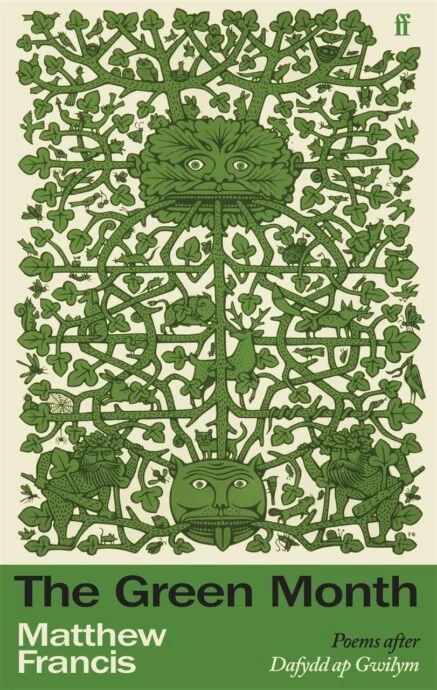
Dafydd ap Gwilym, the pre-eminent poet of Wales, explored love, desire and the natural world with startling frankness and virtuoso wit. In a sequence freely adapted from Dafydd’s work, Matthew Francis brings him to life for the modern English-speaking reader: as he waits in the woods for his lover, ogles the girls in church or causes chaos during a midnight assignation.
Plants, birds and animals are fondly invoked while weather and the elements – wind, waves, fog and ice – play their part. Passionate in his treatment of sexual themes, Dafydd is equally ready to make fun of his own susceptibility. The Green Month introduces an original and lovable poet who speaks freshly to us from deep in our islands’ past.
Faber publisher’s website
“I chose to write poems ‘after’ Dafydd rather than translations – not changing the setting or period but aiming to bridge the imaginative gap between his world and that of the modern English-speaking reader.”
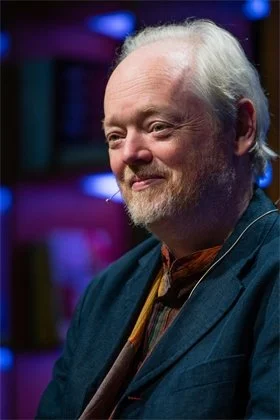
‘In The Green Month, Matthew takes the key to the original poems to be Dafydd’s own personality – humorous, self-mocking, fascinated by nature and keenly observant of it, fascinated also by sex and unusually honest about it, fascinated above all by words and the craft of writing. By making this man come alive, Francis can get inside the skin of the poems, as he does in “Fox”, which is both a brilliant sketch of a fox and Dafydd’s rueful admission of his own sexual obsessions:
Then watch out, hens! The gentleman in the gamey coat
has a nose for feathered flesh. Men may chase him
for fifty furlongs, but he’ll be back
sniffing around your bedroom.
I know how he feels.
This verse also demonstrates how Francis chose to tackle the poems technically.
Dafydd was a very formal poet, and while wisely not attempting to reproduce cynghanedd in a language not designed for it, Francis felt some formal constraint was necessary and chose this 5-line “tapering syllabic stanza in which each line is shorter than the one before”. It imposes economy, the more so as the poem progresses, and the result is a considerable shortening of some of Dafydd’s longer and more discursive forays into description and metaphor. It produces a poem which is “a snapshot of one of Dafydd’s themes, concentrating on the most striking images and ideas”.
These poems struck me as being very true to Dafydd’s obsessive inventiveness with imagery – the “tattered sheet of snow”, the fogbound man “smothered in fleece, a tick in the weather’s wool” – also to his keen observation of the natural world and to his self-mocking humour. They are also, as one would expect from a combination of Dafydd ab Gwilym and Matthew Francis, hugely entertaining poems in their own right.
Sheenagh Pugh
‘The Green Month’ published by Faber in autumn 2025, is Matthew’s sixth poetry collection